
Are Boradors Aggressive?
No. Boradors are not generally considered an inherently aggressive mix. Labrador Retrievers are widely known as sociable dogs. Border Collies are working dogs with strong herding instincts. Neither parent breed guarantees how a puppy will behave. A Borador can growl, snap or bite when it is frightened, in pain, guarding something or overwhelmed. Learn the warning signs and act early.
Key Takeaways
- ✅ Neither parent breed was developed for fighting or guarding.
- ✅ Herding drive, fear, and pain are the usual explanations. Each can often be managed with professional help.
- ⚠️ No mixed breed comes with a behavior guarantee. A Borador with a rough start can bite.
- ⚠️ Growling is a warning, not a crime. Punishing it removes the warning, not the feeling.
- ⚠️ A sudden behavior change is a vet question before it is a training question.
- ❌ Don’t wait for a bite before you call a behaviorist.
Table of Contents
Borador Aggression at a Glance
| Question | Short answer | Why |
|---|---|---|
| Are Boradors aggressive? | Not by nature | Neither parent breed was developed for fighting |
| Do Boradors bite? | Any dog can | Fear, pain, and guarding are the usual triggers |
| Is herding nipping aggression? | No | It is a working instinct aimed at movement |
| Common cause | Fear | The AKC calls fear the most common cause of aggression in dogs |
| Do they grow out of it? | Not on their own | Practiced behavior gets stronger, not weaker |
| When to get help | A growl that repeats, or any snap | Early help is cheaper and safer than a bite record |
What Counts as Aggression in a Borador?
Aggression covers a range of behaviors that threaten or harm another animal or person, from a growl to a bite. The reasons behind it differ: fear, conflict, guarding, pain, and learning all show up. Behavior consultant Michael Shikashio offers a short working definition: behavior used to increase distance from a threat. The Merck Veterinary Manual names fear, anxiety, conflict, genetics, and previous learning as the usual ingredients.
The ASPCA lists the steps dogs often show first: a still, stiff body, a low growl, bared teeth, a snap, then a bite. The ASPCA also warns that dogs do not always follow that order, and that just milliseconds can separate a warning from a bite.
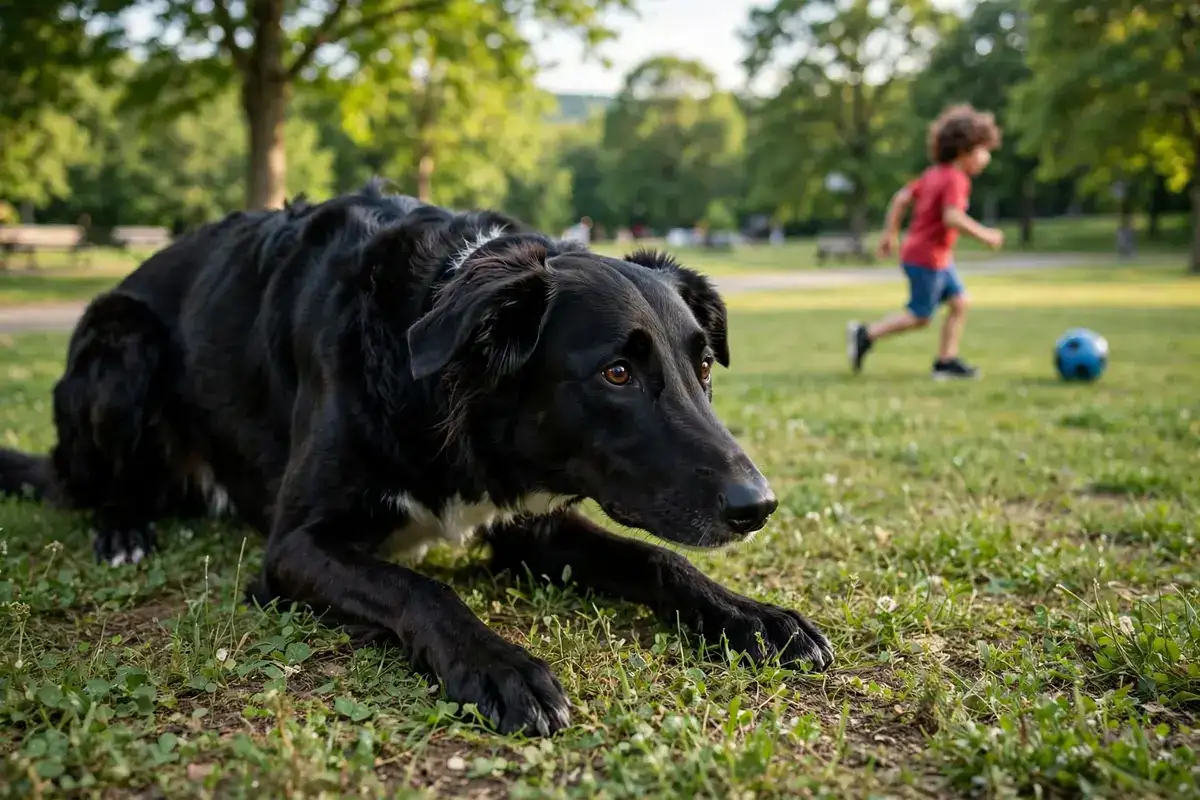
Plenty of Borador behavior looks aggressive and isn’t. Chasing a bike is herding. Grabbing a sleeve is mouthing. Staring at the cat is a stalk. None of those is a dog trying to hurt someone.
Aggression can be a single incident or a repeated response to one situation. It often comes with a stiff body and a hard eye, and it usually gets worse when the dog is cornered. Look at the body language, at what happened just before, and at whether the dog has done it before. Never wait for a pattern before you take a snap or a bite seriously.
Is Herding Instinct the Same as Aggression?
No. The Border Collie side of a Borador was built to move animals, not to hurt them.
The AKC calls the Border Collie “a remarkably bright workaholic.” The breed moves stock with a stare, a stalk, and a chase. The AKC notes that the sequence usually stops there. A dog can still nip when it is wound up or blocked, and the nip is the part owners notice.
So when your Borador chases the kids, stares down the cat, or nips at running feet, you are probably watching herding drive. This is normal for this mix, but it still needs managing because teeth on skin can frighten people and hurt a child.
| What you see | What drives it | What to do |
|---|---|---|
| Fixed stare at the cat, still body | Stalk, an early herding step | Call away before the stare locks, then reward the recall |
| Sprinting at kids or bikes | Chase | Teach a stop cue and use a long line outdoors |
| Quick nip at heels or sleeves | Herding or over-arousal | End play, redirect to a tug toy, restart calmer |
| Mouthing your arm in play | Normal puppy mouthing | Swap your arm for a toy and pause the game |
| Circling the other dog | Gathering | Separate, add a break, keep play short |
Herding drive is not a fault you remove. It is a need you fill. A Borador with a job is often a calmer dog than one with a full tank and no outlet. Teach the nipping out early, and it stops. The drive itself stays, as the Borador owner stories on this site show.
Why Some Boradors Growl, Snap or Bite
When a Borador does mean to push someone back, the reason usually sits in one of five groups. Herding is covered above, and it is not aggression. The fix changes with the group, so name it before you train.
1. Fear and Being Trapped
A scared dog has three options: run, freeze or fight. Take away the exit and only one is left. VCA’s veterinary behaviorists name fear-related aggression as one of the most common types they see. It shows up at the vet, on a leash, and when a stranger leans over the dog.
Start with space. Give the dog an exit, and the growl often stops on its own.
2. Pain or Illness
Pain lowers patience. A sore hip, an ear infection, or a bad tooth can turn a tolerant dog into a snappy one. The change usually arrives fast and comes with other signs. Our guide to common Borador health issues lists what to watch for.
3. Resource Guarding
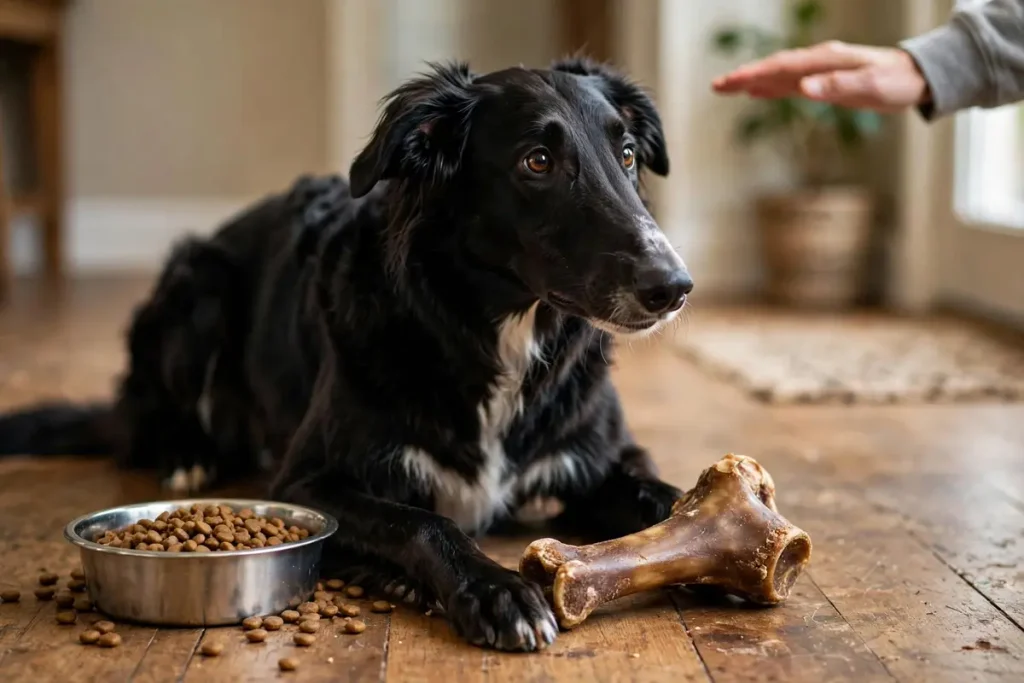
Food bowls, bones, stolen socks, and the sofa are common flashpoints. A guarder is not a bad dog. It expects you to take something. The ASPCA’s food guarding guide and the AKC’s resource guarding article both start with distance: do not approach the dog or take the item. Repeated or intense guarding needs a behavior professional, because a homemade plan can get someone bitten.
4. Over-Arousal and Frustration
Some nips happen at peak excitement, not at peak threat. A dog that has been chasing a ball for ten minutes can lose its off switch. Leash frustration is the same story in a smaller space: the dog wants to greet, can’t, and the energy spills out of its mouth.
5. Practice
Behavior that works gets repeated. The AKC puts it plainly: the more a dog practices aggression, the more deeply that behavior can become established. That is the whole case for early help. A dog that has snapped three times is harder to change than one that has snapped once.
Guarding the house, the car or the family is a slightly different question. Our guide to whether Boradors are protective covers that side.
How to Tell Normal Behavior from Aggression
There is no published baseline for how much growling is normal in a Borador. Use a pattern test instead.
| What you see | Usually normal | Get help |
|---|---|---|
| Growl over a bone | One warning, then the dog settles once you step back | A snap or bite when someone walks past |
| Nipping in play | Puppy mouthing that stops when play stops | Nipping that breaks skin or keeps going after a break |
| Barking at strangers | Short alert barking that ends when you call | Lunging at the fence or gate with a hard stare |
| Reaction to handling | Mild wriggling during nail trims | A growl when you touch one spot, every time |
| Reaction to other dogs | Noise and posturing that ends in a normal greeting | Freezing, then an unprovoked attack |
Two patterns push a dog out of normal. The first is a short fuse that keeps getting shorter. The second is a warning stage that disappears. If a dog that used to growl now skips straight to a snap, take the change seriously. Punishment may have taught it to drop the warning, but pain, rising fear or a stronger trigger can also speed up a reaction. That is a case for a vet and a behavior professional, not a guess.
Does the Border Collie Side Affect Borador Behavior?
No breed carries a bite in its DNA. Breed tells you what a dog was built to do, not how that dog will act in your kitchen.
The Labrador half is the easy half. The AKC calls Labs “famously friendly.” The Collie half adds drive and a need for work. The AKC calls the Border Collie “maybe a bit too amazing for owners without the time, energy, or means to keep it occupied.”
Experience, training, and health decide what a dog does with the instincts it was born with. A dog that missed normal life before 16 weeks starts behind. A dog in pain can turn fast. A dog that learned growling works will keep growling.
Mixed breed caveat: A Borador is a cross, not a standard breed. Two puppies from the same litter can behave very differently. Much of what we know about this mix comes from the two parent breeds, not from studies of the mix itself. Our complete Borador breed guide covers the size, coat and health side.
How Early Socialization Affects Borador Behavior
Puppy development has a window, and the sources do not agree on the exact dates. VCA puts the best age for socialization between 3 and 16 weeks. Purdue’s canine welfare researchers say the sensitive period lasts until 12 to 16 weeks. The AKC, quoting trainer Pat Hastings, gives 5 to 16 weeks.
The dates differ because puppies differ. All three agree on the principle: early, calm exposure shapes how a dog meets new things later.
Go at the puppy’s pace and keep each meeting positive. Introduce people, sounds, surfaces and everyday situations in small steps, and watch for signs of fear before adding more. A busy Saturday at a market is not the goal.
A puppy raised with little exposure can miss much of this window. That does not make the dog dangerous, and learning does not stop at 16 weeks. It means you start the work later, slower, and usually with a trainer. Our guide to choosing a Borador puppy or rescue covers the questions to ask about a pup’s start.
What Makes Aggression Worse in Boradors?
- Punishing a growl. The AKC’s point is blunt: a dog that attacks without warning is a bigger risk than one that warns. Scold the growl and you train a silent dog.
- Cornering or holding the dog down. It removes the exit and forces a fight.
- Flooding. Forcing a scared dog closer to the thing it fears does not build courage. It builds a bite.
- Aversive collars. Pain-based tools add pain to a dog that may already be in pain.
- Skipping the vet. Behavior that changes in a week is a health question first.
- Repeating the trigger with no plan. Every rehearsal makes the habit stronger.
How to Manage Aggression in a Borador
The plan depends on the cause. A frightened dog needs something different from a dog guarding its food or chasing the postman.
- Give the drive a job. Scent games, a puzzle feeder, a flirt pole, and a short training session each day.
- Teach a stop cue. “Stop,” “leave it” and a solid recall give you a brake for the chase.
- Reward calm, not just obedience. Catch the dog lying quietly and pay it.
- Ask about a muzzle if there is a bite risk. A vet or behavior professional can show you how to fit a basket muzzle and introduce it with rewards. Never force one onto a frightened dog, and never use it instead of separation and supervision.
Training method matters as much as the plan. Reward-based work is what the AKC, ASPCA, and VCA all describe. Our Borador training guide sets out a step-by-step version for this mix. A dog that nips in play is not a bite record. If you are still choosing a mix, our guide to whether Boradors make good pets covers the rest.
Who to Call
The AKC suggests four options: a veterinary behaviorist, an animal behaviorist, a certified behavior consultant, or a dog trainer with experience handling aggression. Ask what cases they have worked with. Ask whether they will visit your home. A proper assessment starts with your dog’s history and the exact moment of the last incident.
What to Do If Your Borador Bites Someone
Work through this in order. Do not skip the first step because the bite looked small.
- Separate the dog from the person, calmly and without punishment
- Wash the wound and get medical assessment for the person
- Get urgent medical help for puncture wounds, bites to the hands or face, and any bite to a child
- Write down what happened just before the bite
- Keep the dog on a leash and a muzzle around visitors
- Book a vet check and a qualified behaviorist in the same week
- Tell everyone who handles the dog, including groomers and vets
One bite does not make a dog hopeless. A dog that has bitten three times with no plan in between is a different case, and the behaviorist should say so honestly.
When Should You Contact a Vet or Behaviorist?
Veterinary behaviorists list medical problems as a cause of aggression. So a check-up comes first when the behavior is new.
- A dog that was fine last month and is not fine now
- Growling when a specific body part is touched
- New food guarding in an adult dog that never guarded before
- Snapping at night, or confusion in an older dog
- Any sudden change along with eating, potty or sleep changes
A Borador that turns reactive out of nowhere is the same puzzle, and the checks follow the same order. Our guide to the medical causes of sudden aggression in Border Collies walks through them for the herding side of the family.
Ask your vet for a referral if you need one. A check-up rules out the medical causes first, then a behavior professional takes the training side.
Borador Aggression Myths
| Myth | What’s actually true |
|---|---|
| “He growled, so he’s a bad dog” | He communicated. That is the behavior you want to keep |
| “He’s trying to be the boss” | Dogs are not running a workplace hierarchy. Fear and learning explain most cases |
| “A rescue is always damaged” | Many rescues settle well. Ask what the dog has already learned |
| “Training fixes it in a week” | Behavior change takes months, and management comes first |
| “He’s half Collie, so he’ll herd and nip forever” | The drive stays. The teeth-on-skin habit does not have to |
Borador Aggression FAQ
Are Boradors aggressive by nature?
No. Both parent breeds are known for sociable or working traits rather than fighting, but no breed guarantees how a single dog behaves. A bad start, pain or fear can produce a dog that bites.
Do Boradors bite?
Any dog with teeth can bite. Fear, pain, resource guarding, and frustration are the usual triggers. Some dogs show warning signs first, but the signals can be subtle or missed, so never assume a dog will growl before it bites.
Why does my Borador nip at my kids’ heels?
Moving feet switch on herding drive, and the nip is usually that drive plus excitement. Manage it with a stop cue, a tug toy, and a rule that running games pause the moment teeth touch clothes.
Are Boradors aggressive to strangers?
Many are sociable with unfamiliar people, but individual dogs differ. Fear, a bad experience, or a lack of early socialization can make one uncomfortable. Give the dog space and do not force an introduction.
Is growling a sign my Borador will bite?
It is a sign the dog wants space. Growls often stop a situation before it becomes a bite. Take the warning seriously and change the setup.
Should I punish my Borador for growling?
No. The AKC warns that punishing a growl can produce a dog that bites without warning. Fix the cause and reward the calmer behavior instead.
Are male or female Boradors more aggressive?
There is no reliable answer for this mix. Sex is a weak predictor next to the individual dog’s health, history, and training. Judge the dog in front of you, not the sex.
Can a Borador be trained out of aggression?
Early help usually manages it well. A board-certified veterinary behaviorist can tell you what to expect for your dog. No trainer can promise a cure.
Does neutering stop aggression?
Not on its own. Surgery is a health decision, and it does not replace a training plan. Talk to your vet about your dog’s age, health, and history.
Are Boradors aggressive with other dogs?
Herding behavior can look pushy to other dogs. A dog that was rushed at a park may become defensive. Keep early meetings short and calm.
Why did my Borador suddenly become aggressive?
Sudden change points to pain, illness, a new trigger, or a hearing or sight loss. Book a vet check before you change the training plan.
Are Borador puppies aggressive when they play?
Puppy play includes growling, mouthing, and body slamming. That is not aggression. Watch for a puppy that cannot stop, or that keeps going after the other dog says no.
Is a Borador safe with cats?
The chase instinct is the risk. Introduce them slowly and keep a high perch for the cat. Never leave them alone until the dog ignores the cat.
Are Boradors aggressive to their owners?
Owner-directed aggression is not a breed trait, and it usually points to pain, fear, or resource guarding. A dog that growls when you touch one spot needs a vet check before a training plan.
Related Mixed Breeds Guides


Borador Aggression Glossary
- Herding drive: The instinct to gather and move other animals, using a stare, a stalk, and a chase.
- Fear aggression: Growling or snapping that starts when a dog feels trapped or threatened.
- Resource guarding: Defending food, toys, people or a resting spot from anyone who comes close.
- Arousal: How switched on a dog is. High arousal makes a dog faster to nip and slower to think.
- Trigger stacking: Small stresses adding up until one more thing tips the dog over.
- Counterconditioning: Pairing a scary thing with food so the dog’s feelings about it change.
Sources
- ASPCA, Aggression
- ASPCA, Food Guarding
- AKC, Aggression in Dogs: Signs, Symptoms, Treatments
- AKC, Why Dogs Growl and What Their Growls Really Mean
- AKC, Why Does My Dog Herd My Kids?
- AKC, Creativity and Critical Timing Are Key to Puppy Socialization
- AKC, Resource Guarding in Dogs
- AKC, Border Collie breed page
- AKC, Labrador Retriever breed page
- VCA Hospitals, Dog Aggression Diagnosis and Overview
- VCA Hospitals, Puppy Behavior and Training: Socialization and Fear Prevention
- Merck Veterinary Manual, Behavior Problems in Dogs
- Purdue Canine Welfare Science, Developmental Stages
Research Note
There is no published behavioral study of Boradors as a cross. Everything here comes from the two parent breeds and from general canine behavior research. We did not invent rates for this mix, because none exist.
Medical disclaimer: This guide is for information only. It is not a substitute for veterinary or behaviorist advice. A dog that has bitten, or that is showing sudden behavior change, needs a professional assessment.

Leave a Reply
You must be logged in to post a comment.